Playing this video transfers data to YouTube (Google). Privacy policy

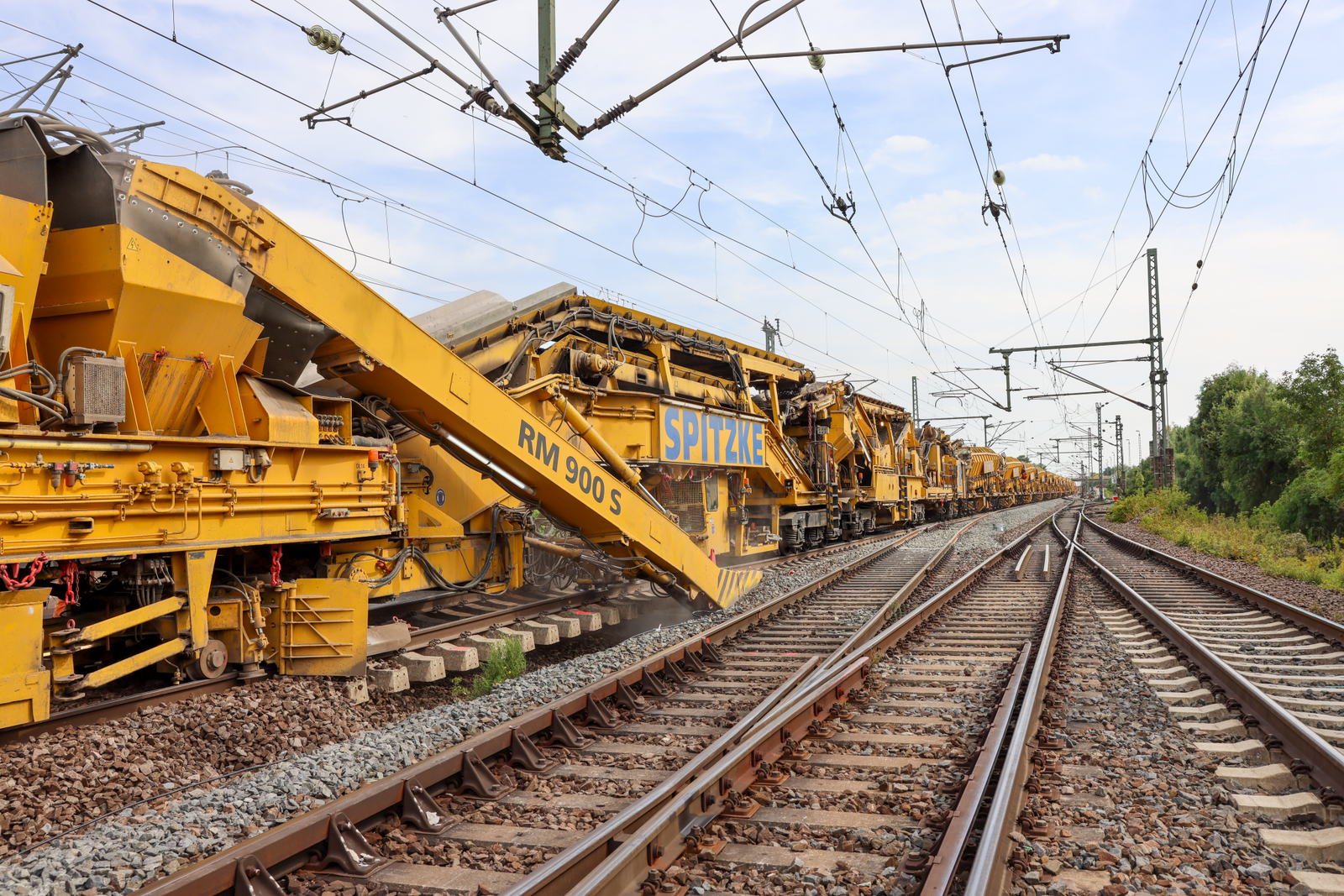
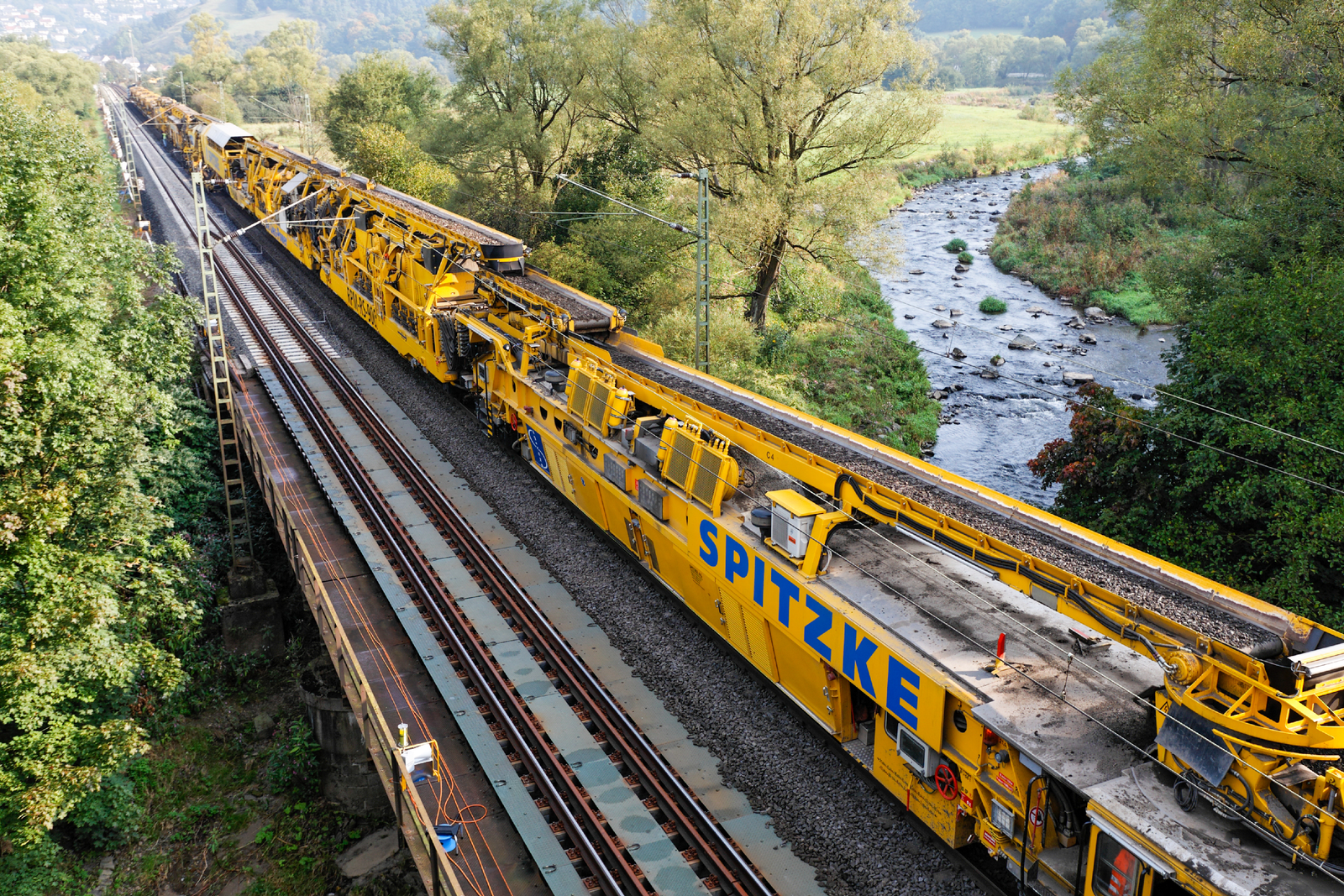
Formation rehabilitation machine with integrated ballast recycling RPM-RS-900
Ballast cleaning, formation rehabilitation, recycling - Track-laying
The RPM-RS-900 was designed for formation remediation and for processing track ballast, and is the longest machine in SPITZKE’s technology park. Its strength lies in its versatility. Formation rehabilitation, ballast cleaning and ballast recycling are all achieved within a single machine complex. The ballast is excavated, recycled, re-laid, compacted and stabilised. The soil is excavated, the new FPL material laid, profiled and compacted. All operations are rail-bound, without blocking the adjacent track. This enables short track possessions and high track availability.

Funktionsmerkmale
RECYCLING WORK
- Excavation, recycling and transport of old ballast
- Laying of recycled or cleaned ballast
- Removal of soil and transport of excavated soil on MFS wagons or optionally on wagons next to the working track
- Ballast residues are transported away on MFS wagons or optionally on wagons or trucks next to the working track
- Two free-swinging vibrating screens with double pre-separation (scalping)
- Metered feed, flexible laying height and width, uniform compaction of FPL material, parallel laying of geosynthetics and/or geogrids
- Metered feed, laying, and uniform compaction and stabilisation of new ballast
FPL RECYCLING WORK
- Simultaneous excavation of the ballast and soil
- Excavated soil is transported away on MFS wagons or optionally on wagons or trucks next to the working track
- Crushing and recycling of the ballast material
- Controlled mixing of the recycling material with the new added FPL material
- Controlled placement and compaction of the material as a formation protection layer
BALLAST CLEANING WORK
- Excavating the ballast
- Two free-swinging vibrating screens with double pre-separation (scalping)
- Flexible ballasting using a swivelling conveyor belt with level control
- The ballast formation can be compacted by means of compactors
- New ballast can be laid in parallel using trailing MFS units
- Integrated, continuously-working tamping machine with satellite control, 16 tampers and front compaction
- Trailing, integrated sweeping shaft
- Cleaning power up to 900 m³/h
- Complete ballast renewal (complete ballast replacement) in a single operation (full excavation)
- Ballast recycling and placement of recycled ballast
- Laying of geosynthetics and/or geogrids


Technical specifications
- Total length over buffers (without MFS wagons)
- 198.240 mm
- Gauge
- 1.435 mm
- Vehicle profile
- G 2
- Maximum width / height
- 3.000 mm / 4.650 mm
- Total output
- approx. 2.800 kW
- Maximum speed in train formation
- ≤ 100 km/h
- Maximum self-propelled speed
- ≤ 19 km/h (with 800 t, up to 15‰)
- Overall weight (empty, incl. 1 MFS 40-D)
- approx. 800 t
Performance parameters
- Recycling rate
- up to 100 m/h
- Performance of the 2nd excavating chain (formation)
- up to 900 m³/h
- Performance of the 1st excavating chain (ballast)
- up to 350 m³/h
- Ballast cleaning performance
- up to 900 m³/h
- Maximum height of frost blanket layer (FBL)
- 500 mm (Proctor density 100 %)
- Maximum finished height of compacted formation protection layer (FPL), (from 4 m to 6.5 m placement width, continuously adjustable)
- 500 mm (Proctor density 100 %)
- Max. excavation width of the 2nd excavating chain (formation)
- 4.050 mm - 5.600 mm
- Excavation width can be extended on both sides
- 650 mm each
- Maximum excavation depth of the 2nd excavating chain from top of rail
- 1.200 mm
- Maximum excavation width of the 1st excavating chain (ballast)
- 4.000 mm
- Excavation width can be extended on both sides
- 300 mm each
- Maximum excavation depth of the 1st excavating chain from top of rail
- 700 mm
- Minimum working radius
- 280 m at 160 mm track cant
- Minimum radii for activation and removal
- 350 m
- Minimum driving radius
- 150 m